Improving machine management through a fully digital user journey
Jacob Douwe Egberts Professsional
Services
- Concept Design
- Product Implementation
Role
UX Designer
Jacob Douwe Egberts Professional leases and sells coffee machines to small, medium, and large organisations. Before this project, the digital journey stopped early. Customers could explore machines and report errors, but most steps around leasing, onboarding, and ongoing management still required manual processes and human intervention.
Why it mattered
The lack of end-to-end digitalisation slowed down the entire experience. Many people were involved across the user journey. This increased costs and friction, especially on the service and maintenance side.
Challenge
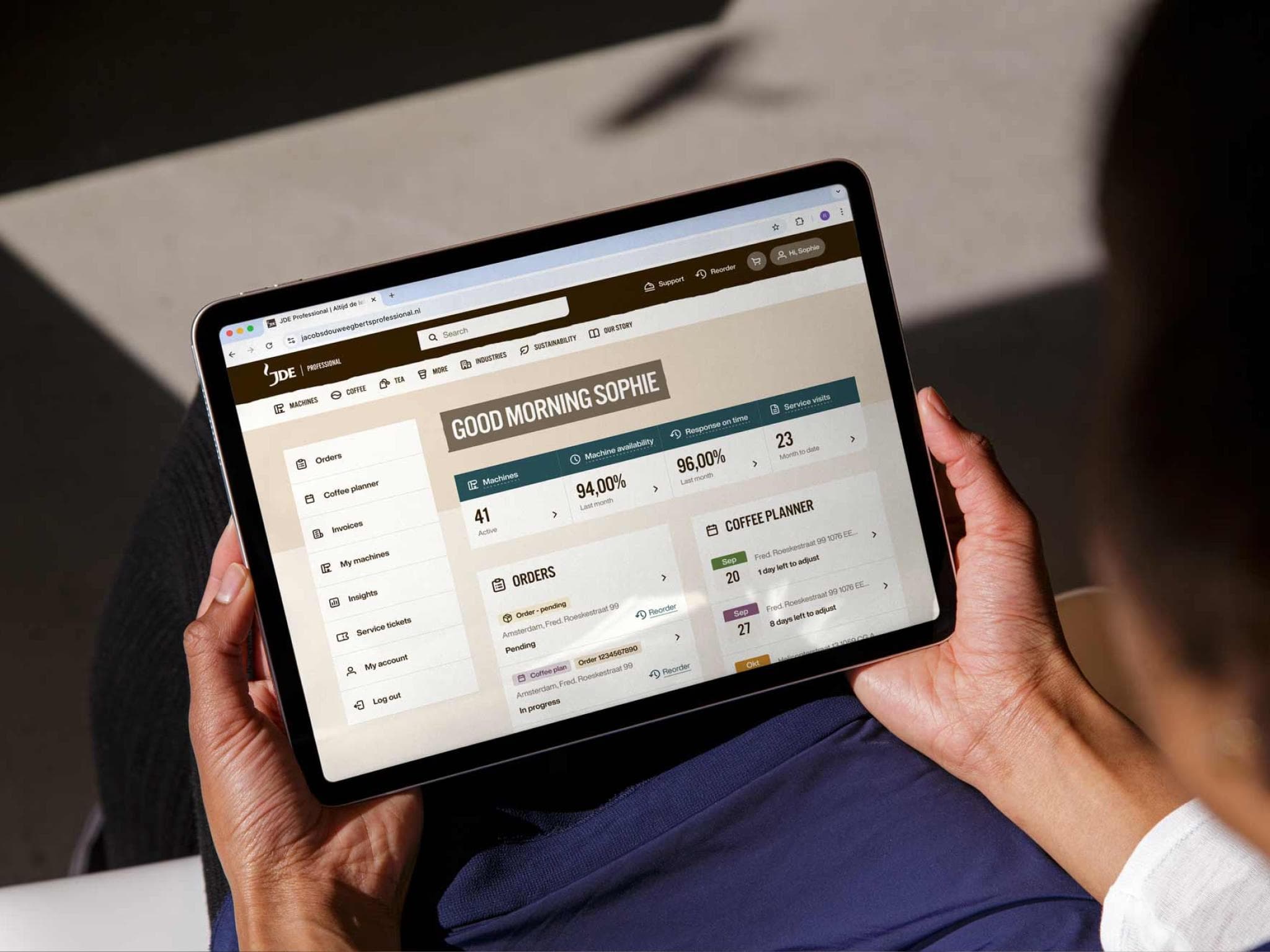
In the concept vision the main tension was balancing personal sales advice with the ability for customers to move forward independently. From which we defined a clear North Star. The focus for MVP was creating a management focused area for large organisations, allowing them to identify machine statuses, review invoicing and manage maintenance requests.
Timeline and constraints
I worked on this project for about one year. After this development and design continued for another year. The system had to support a wide variety of machines, each with different capabilities for sharing data. Some machines updated in real time, others where read manually once per quarter. The design needed to make these differences understandable without confusing users. The project also involved many stakeholders and a fully remote development team, while design and implementation support ran in parallel at a high pace.
My role
I worked alongside another designer who led the overall design direction. We each owned specific product areas end to end. My responsibilities covered concept development, detailed design, documentation, and close collaboration with development to support implementation and handover.
Approach
We started by hosting a journey-mapping to define a shared North Star for the entire end to end experience. From there, we explored concept designs and evaluated them against user needs, organisational goals and real users. These concepts were translated into detailed designs for the MVP, with a clear view on MVP+ and future phases. Designs were validated through user testing again and again, on which we iterated accordingly. Throughout the project, I documented decisions in detail and worked closely with development to ensure the designs could be built as intended.
A key design judgment was pushing back on existing stakeholder preferences when user research organisational requirements where not aligned with users desires. We deliberately reduced scope for the MVP, focusing on what users actually needed to complete their tasks. Less functionality, executed clearly, proved more valuable than carrying legacy patterns forward.
Outcome
The project resulted in a thoroughly validated MVP that successfully went live for large customers. A design system was created and applied to support consistency and future growth. The solution was fully responsive across mobile, tablet, and desktop. In parallel, we delivered the first designs to guide future features beyond the MVP.
Reflection
This project shows how I work across the full lifecycle of a product. From defining a North Star to shaping a feasible MVP, from detailed design to implementation support and handover. I focus on clarity, disciplined scope, and collaboration, especially in complex environments where systems, data, and stakeholders all need to align.
This project is part of work as an employee of Soda Studio.